


Confluence 2026 - Register Interest

Clarity Act Resource Hub

Read Our Latest

CahillNXT is the premier destination for clients seeking sophisticated counsel to resolve their most challenging legal, regulatory, and business problems at the intersection of finance and frontier technologies such as digital assets, artificial intelligence (AI), and prediction markets. We are entrepreneurial, creative, practical, responsive, and relentless in pursuing our clients’ goals. Our tech-fluent, cross-disciplinary team handles the most consequential transactional, regulatory, litigation, and government enforcement matters that our clients face throughout the lifecycle of their ventures.
Leveraging Cahill’s more than century-long track record of excellence and innovation in guiding traditional financial institutions through seismic transformations in the structure and regulation of capital formation and trading markets, the firm’s CahillNXT practice is now at the forefront of helping clients navigate the maze of opportunities and risks that flow from the world’s next wave of financial innovation arising from the advent of blockchain technology, crypto assets, AI, prediction markets, and other frontier technologies.
These technologies are converging. Autonomous software agents now hold wallets, move value, and transact in regulated markets; large language models are trained on data whose ownership and provenance are contested; and the regulators who spent the last decade deciding how existing law applies to crypto assets are now deciding how it applies to machine intelligence. CahillNXT advises clients where those questions arrive together—at the confluence of code, capital, and free speech.
About The Team
Our globally recognized Digital Assets, AI, and Frontier Technologies team is led by some of the most accomplished and creative “tech native” regulatory experts, former prosecutors, trial lawyers, tax counsel, investigators, corporate advisors, and dealmakers. The team is supported by a preeminent software developer and engineer who helps our clients bridge the gap between computer code and the law, and one of our partners is himself a working developer whose research interests include large language models and natural language processing.
The Cahill partners on the CahillNXT team are renowned for achieving exceptional results for institutional and individual clients in their thorniest legal challenges involving frontier financial technologies, including complex transactions ranging from startup formation and venture fundraising to mergers, acquisitions, asset purchases, joint ventures, and complex governance structuring for decentralized autonomous organizations (DAOs), as well as high-stakes criminal and regulatory enforcement matters, internal corporate investigations, and civil litigation relating to digital assets, agentic AI commerce, prediction markets, and other emerging technologies. Our lawyers are also widely recognized as leaders in advising businesses, entrepreneurs, founders, developers, public officials, directors, and officers in these fields on structuring business lines, financial products, and transactions to comply with U.S. securities, commodities, tax, anti-money laundering, sanctions, national security, export control, tariff, and money transmission laws, the EU’s Markets in Crypto-Assets Regulation (MiCA) and Markets in Financial Instruments Directive (MiFID II), and other laws and regulations that apply to these activities.
 Samson A. Enzer
Co-Chair and Partner, Digital Assets, AI, and Frontier Technology Practice
Samson A. Enzer
Co-Chair and Partner, Digital Assets, AI, and Frontier Technology Practice
A distinguished former federal prosecutor, Samson “Sam” Enzer is the founder and Co-Chair of CahillNXT, the firm’s globally recognized Digital Assets and Emerging Technology practice, and a member of the firm’s top-ranked Litigation, White Collar Defense, and Government Investigations groups.
Since launching Cahill’s Digital Assets and Emerging Technology team, Sam has been recognized as a leading litigator and strategic adviser in the areas of Crypto-Asset Disputes and FinTech by Chambers and Legal 500, and has been named a national Law360 MVP in FinTech and a National Law Journal Trailblazer in FinTech, Cryptocurrency and Blockchain. He has also been called a future star by Benchmark Litigation.
An accomplished trial lawyer and corporate adviser, Sam has successfully guided multiple prominent companies and individuals through “bet the company” civil litigations and high-stakes regulatory enforcement proceedings, criminal matters, internal corporate investigations, and corporate crises, often in cases involving the financial services, cryptocurrency, or FinTech sectors. Leading institutions also regularly turn to Sam for advice on regulatory compliance and corporate governance issues relating to a wide range of emerging technologies and markets, including decentralized finance (DeFi), artificial intelligence (AI), carbon offsets, precious metals, biometric data privacy, and online gaming. According to Chambers, clients have lauded Sam for pioneering creative and practical ways to help them lawfully structure businesses, products, investments, fundraising initiatives, payment rails, and other transactions to comply with U.S. securities, commodities, anti-money laundering, sanctions, and money transmitter laws.
Sam has been described as “one of the leading cryptocurrency enforcement practitioners to come out of government service in recent years” by The National Law Journal and as the “SDNY Crypto Ace” by Law360. He is regularly sought out by leading cryptocurrency trading exchanges, asset managers, derivatives trading firms, investment advisers, market makers, broker-dealers, FinTech payment platforms, digital wallet service providers, DeFi protocol developers, blockchain startups, private equity funds, venture capital firms, banks, and businesspeople seeking counsel concerning digital assets and other emerging technologies.
 Lewis Rinaudo Cohen
Co-Chair and Partner, Digital Assets, AI, and Frontier Technology Practice
Lewis Rinaudo Cohen
Co-Chair and Partner, Digital Assets, AI, and Frontier Technology Practice
Lewis Rinaudo Cohen is the Co-Chair of Cahill’s globally recognized Digital Assets and Emerging Technology practice group, and focuses on the use of blockchain, crypto assets and tokenization across all aspects of the capital markets and all areas of economic activity.
With the emergence of blockchain technology, Lewis early on identified the important role this technology would play across not only the financial markets but virtually all aspects of the commercial landscape, and is deeply committed to advising clients in this area.
Lewis’ career-long experience has spanned the full-spectrum of matters from large-scale traditional initial public equity and debt offerings and a wide range of securitization and other structured financing transactions to advising on legal issues relating to the launch of new blockchain-based decentralized projects. Over Lewis’ career, he has represented issuers, underwriters, banks and others on a wide range of traditional capital market transactions.
 Sarah Weiyang Chen
Partner, Digital Assets, AI, and Frontier Technology Practice
Sarah Weiyang Chen
Partner, Digital Assets, AI, and Frontier Technology Practice
Sarah Chen advises clients on all matters in the space of digital assets and emerging technology, including general corporate, mergers and acquisitions, venture capital investments, securities and financial regulatory matters.
Sarah represents a variety of clients in the digital asset space that range from blockchain development companies, foundation entities, digital asset marketplaces, tokenization platforms, to venture capital firms, fintech companies and traditional financial institutions. Sarah provides legal advice on securities, commodities and other laws and regulations that may apply to activities involving digital assets and the use of blockchain technology.
 Jonathan Galea
Partner, Digital Assets, AI, and Frontier Technology Practice
Jonathan Galea
Partner, Digital Assets, AI, and Frontier Technology Practice
Jonathan Galea is a counsel in the London office of Cahill Gordon & Reindel (UK) LLP, where he focuses his practice on cryptocurrency regulation matters.
Jonathan is one of the first crypto-native lawyers, with his involvement in the industry spanning back to 2013. After publishing a legal thesis in 2015 titled, “The Effect of Bitcoin on Anti-Money Laundering Laws,” he went on to found and lead a crypto regulatory consultancy firm with clients ranging from crypto exchanges to prominent DeFi projects and stablecoin issuers.
Jonathan is seen as one of the leading experts on the EU’s Markets in Crypto-Assets Regulation (MiCA), leveraging his extensive experience to effectively guide clients across its applicability. He has also done extensive work in policy and legal drafting, which includes co-authoring Malta’s pioneering Virtual Financial Assets framework.
 Gary E. Kalbaugh
Partner, Digital Assets, AI, and Frontier Technology Practice
Gary E. Kalbaugh
Partner, Digital Assets, AI, and Frontier Technology Practice
Gary E. Kalbaugh is a nationally recognized leader in commodities, futures, and derivatives law.
Gary is a partner in the New York office of Cahill Gordon & Reindel LLP as well as a Special Professor of Law at the Maurice A. Deane School of Law at Hofstra University, where he teaches derivatives law and banking law.
A preeminent authority in the derivatives field, Gary is the author of the principal treatise Derivatives Law and Regulation (3rd ed. 2021) and serves as Editor-in-Chief of the Futures and Derivatives Law Report, the foremost industry publication. He is a past chair of the New York City Bar Association’s Committee on the Regulation of Futures and Derivatives and has over 15 years of experience as a professor teaching derivatives and banking law.
 John MacGregor
Partner, Digital Assets, AI, and Frontier Technology Practice
John MacGregor
Partner, Digital Assets, AI, and Frontier Technology Practice
He concentrates his practice on advising corporations – including global financial institutions, media companies, insurers, and technology startups – and their executives and board members in complex securities, commercial, and antitrust matters in federal and state courts. John is admitted to practice in both New York and California.
 Jason Schwartz
Partner, Digital Assets, AI, and Frontier Technology Practice
Jason Schwartz
Partner, Digital Assets, AI, and Frontier Technology Practice
Jason Schwartz is a tax partner in CahillNXT, Cahill’s premier practice for Digital Assets and Emerging Technology.
He specializes in tax issues relating to digital assets, financial products, securitizations, funds, treaties, and lending.
Jason is ranked by Chambers USA and Legal 500 US and has authored numerous tax articles, a Bloomberg BNA Tax Management Portfolio on the taxation of CLOs, and a chapter for Practicing Law Institute on the taxation of digital assets. He is frequently asked to speak on panels and podcasts on a wide range of topics relating to tax. Jason’s clients have referred to him as a “fantastic tax lawyer” who is “knowledgeable, smart, and responsive” and “provides very practical guidance.”
 Gregory Strong
Partner, Digital Assets, AI, and Frontier Technology Practice
Gregory Strong
Partner, Digital Assets, AI, and Frontier Technology Practice
Gregory Strong provides strategic regulatory and litigation advice to clients engaging with blockchain and crypto assets.
Greg provides strategic regulatory advice to clients engaging with blockchain and crypto assets with a focus on securities, commodities, and consumer protection laws and regulations. He has successfully represented clients before the Securities and Exchange Commission, the Commodities Futures Trading Commission, state securities regulators and various other regulators.
Greg has significant experience successfully engaging with regulators on behalf of clients in the blockchain space with novel legal issues. He was a key member of the team that obtained one of the few no-action letters issued by the SEC with respect to the non-security status of a crypto asset. Greg was also a key member of the team that represented the first successful applicant for a Special Purpose Depository Institution charter before the Wyoming Division of Banking. In addition, he has worked on cutting-edge litigation and transactional matters involving crypto assets.
 Frank J. Weigand
Chair and Partner, Trading & Markets Practice
Frank J. Weigand
Chair and Partner, Trading & Markets Practice
Frank Weigand is Chair of Cahill’s Trading & Markets Group and a member of the firm’s Digital Assets and Emerging Technology Group focusing his practice on securities, commodities and digital assets matters. His clients include a broad range of market participants, including banks, broker-dealers and funds as well as a full spectrum of participants across the digital asset markets.
Frank’s practice includes advising clients on both regulatory and transactional matters, with a particular focus on strategically complex questions and new product development. His deep experience advising regulated entities in traditional markets gives him depth and context to advise on regulatory implications relevant to digital asset matters.
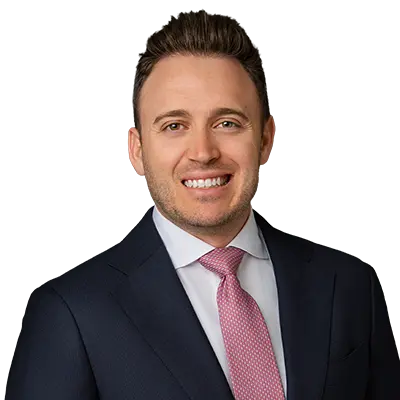 Brian Farber
Counsel, Digital Assets, AI, and Frontier Technology Practice
Brian Farber
Counsel, Digital Assets, AI, and Frontier Technology Practice
Brian Farber is counsel in the New York office of CahillNXT, Cahill’s globally recognized Digital Assets and Emerging Technology practice.
Brian advises clients on all matters in the space of digital assets, including general corporate, mergers and acquisitions, capital markets transactions and securities regulatory. Brian also has deep experience working with product and development teams to design digital asset products in a compliant manner, and guiding regulators through the products’ underlying technology.
 Gregory Mortenson
Counsel, Digital Assets, AI, and Frontier Technology Practice
Gregory Mortenson
Counsel, Digital Assets, AI, and Frontier Technology Practice
Gregory Mortenson is counsel in the New York office of Cahill Gordon & Reindel LLP where he focuses his practice on litigation & regulatory matters with an emphasis on digital assets, securities litigation, commercial litigation, and white collar defense & investigations.
An accomplished litigator & trial lawyer, Greg has handled matters for a wide roster of clients covering multiple substantive areas, including class actions, securities, contract disputes, M&A, fraud, fiduciary duty, conflicts of interest, tort, trade secrets, antitrust, and bankruptcy. Greg’s experience encompasses all phases of litigation and investigations—from initial case assessment through trial and appeal—on behalf of both plaintiffs and defendants, in fora around the country.
Recent News & Insights
CahillNXT and Frontier Technologies
Cahill’s market-leading CahillNXT practice was built on integrated regulatory fluency, technical literacy, and courtroom experience, rather than on siloed capabilities. Our complementary AI practice is built the same way.
We advise AI and crypto startups, financial institutions, trading firms, social media platforms, and other tech companies on the supervisory expectations that now attach to AI, including model validation and governance in regulated firms, SEC and FINRA compliance obligations, and the disclosure and control questions that follow when models inform trading, surveillance, or client-facing decisions. One of our partners serves as Co-Chair of the CFTC’s Artificial Intelligence Workstream within its Future of Finance Committee, teaches derivatives and banking law, and co-developed a global financial institution’s AI training program for its legal department.
Tokenization is securities plumbing rebuilt on a new rail. Members of our team bring decades of market-leading experience in structured finance and the capital markets, all complemented by our deep fluency in the world of technology. Clients bring us the questions that follow: how a tokenized instrument should be characterized, who may hold and transfer it, how transfer agency, custody, settlement, and disclosure obligations map onto a distributed ledger, and how agentic AI activity in tokenized securities should be treated. Three lawyers on our team co-authored The Ineluctable Modality of Securities Law: Why Fungible Crypto Assets Are Not Securities, perhaps the single most influential paper on the application of securities law to digital assets. Our Co-Chair testified before the U.S. Senate Banking Committee’s Digital Assets Subcommittee at its inaugural hearing on a bipartisan market-structure framework. And we publish continuously on the developing regulatory and legislative environment for tokenized real world assets and securities.
Our litigation work is high-stakes and adversarial. The firm successfully defended a leading AI company against a preliminary injunction that threatened its ability to operate; defeated a biometric privacy class action brought under the Illinois Biometric Information Privacy Act on behalf of a self-custody crypto wallet provider; and is currently leading a lawsuit to disrupt an overseas cybercrime ring that used bots and AI-generated content to siphon payouts from a leading social media platform’s creator revenue-sharing program.
Our derivatives practice is led by the author of Derivatives Law and Regulation, the leading legal treatise on U.S. derivatives law and regulation, and previously carried global responsibility for a major international bank’s U.S. derivatives regulatory work as its deputy general counsel. That depth matters as the perimeter of the regulated market moves: perpetual futures have come onshore; event contracts are being lifted out of categorical prohibition and into case-by-case public-interest review; and the line between a hedge, a wager, and a token is being redrawn contract by contract. We counsel prediction market platforms, designated contract markets, futures commission merchants, exchanges, clearinghouses, dealers, trading firms, and protocol developers on product design and self-certification, foreign board of trade access, clearing and margin, and enforcement exposure, including securing a CFTC enforcement declination for the developer of a decentralized prediction market platform.
As autonomous AI agents begin to initiate and settle payments in stablecoins and other digital assets, they pose a question already deeply familiar to our team: who answers for value that reaches a party that should not have received it? Our lawyers have published and advised clients on the intersection of decentralized finance (DeFi) and agentic payments as well as on U.S. sanctions exposure arising from agent-based payments. We counsel clients on designing agentic systems that can withstand OFAC, anti-money laundering, money transmission, and consumer protection scrutiny.
We counsel boards and general counsel on the practical governance of artificial intelligence inside the enterprise, such as the use of AI note takers and assistants in privileged settings, the discoverability of prompts and model outputs, retention and legal hold, and the internal policies that determine whether an AI deployment proves defensible after the fact.
Cahill’s technology intellectual property litigation practice represents plaintiffs and defendants in patent, trade secret, and unfair competition cases involving AI, machine learning, semiconductors, software, and telecommunications: the disputes that determine who owns the models, the data they are trained on, and the hardware beneath them.
Questions about what businesses and individuals may publish—and about what the government may compel or forbid them to say—are questions Cahill has litigated for half a century. From representing The New York Times in the landmark Pentagon Papers First Amendment case to representing Senator Mitch McConnell before the U.S. Supreme Court in the campaign finance cases, Cahill has been the nation’s most prominent defender of free speech, and legendary First Amendment litigator Floyd Abrams—who personally trained many of Cahill’s current litigators—remains Senior Counsel at the firm. That heritage is very much alive: the firm recently secured a Ninth Circuit victory for an industry-leading social media platform, blocking enforcement of a California law (AB 587) that would have compelled disclosure of the platform’s content moderation practices—the same constitutional ground on which AI labeling, provenance, and synthetic-media disclosure mandates are now being contested.
Our Clients
Our clients include some of the world’s leading domestic and international AI and crypto startups, digital asset trading platforms, investment advisers, traditional financial institutions, market makers, hedge funds, broker-dealers, venture capital firms, FinTech payment platforms, digital wallet-service providers, blockchain development companies, foundations, digital asset gaming platforms, NFT marketplaces, stablecoin issuers, and DeFi protocols. Working alongside the firm’s litigation, technology, and intellectual property practices, we also serve AI developers, social media platforms, and technology companies confronting privacy, biometric, content moderation, and intellectual property disputes.
Selected AI Thought Leadership
Recognitions



Slowly, Then All at Once: The Sun Rises on Crypto Market Structure in the U.S.
CahillNXT team examines the latest developments surrounding the Clarity Act following the recent release of the market structure bill text by Senate Banking Committee on May 12, 2026 after months of bipartisan negotiations.
Crypto Under the Hood - The Case for Crypto Dark Pools, or Not?
In light of well-publicized situations highlighting DeFi’s “transparency paradox,” i.e., where the transparency innate in the technology can be its own Achilles heel, we explore how DeFi markets potentially could be structured in a way to protect market participants from exploitation and the relative benefits and drawbacks of doing so.
Cahill Defeats Plaintiffs’ Bid to Freeze Assets in High-Profile “$LIBRA Gate” Class Action
Cahill secured a significant victory for Ben Chow, co-founder and co-developer of the Solana-based decentralized peer-to-peer digital asset trading exchange known as Meteora, by defeating plaintiffs’ request for a court injunction seeking to freeze hundreds of millions of dollars in assets.
CahillNXT Alert – The One Big Beautiful (Crypto Tax) Bill
CahillNXT had the opportunity to review a not-yet-public digital assets legislative package slated for inclusion as an amendment to the “One Big Beautiful Bill,” which now awaits a vote in the Senate.

CahillNXT Publishes Third Issue of Crypto Under the Hood
This article delves into the technological features of Uniswap v4, the legal and regulatory implications of these features, and their potential to reshape DeFi.
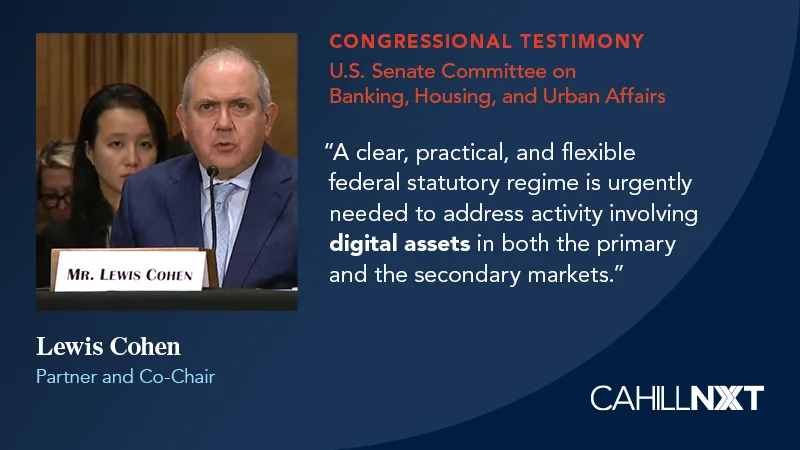
Lewis Cohen Testifies Before U.S. Senate in “Exploring Legislative Frameworks for Digital Assets” Committee Hearing
CahillNXT co-chair and partner Lewis Cohen testified before the U.S. Senate Committee on Banking, Housing, and Urban Affairs.
CahillNXT Lauded in Chambers FinTech 2025
Cahill has been ranked among the leading law firms in Crypto-Asset Disputes and FinTech Legal: Blockchain & Cryptocurrencies in the 2025 guide.